Showing posts with label Brian Tree. Show all posts

Monday, 9 June 2014

Alice Through the Looking Glass: Visually appealing but slightly hollow production


Alice Through The Looking Glass
Stratford Festival
Avon Theatre
By Lewis Carroll
Adapted for the stage by James Reaney
Directed by Jillian Keiley
Approximate running time: 2 hours and 15 minutes (with one 20 minute interval)
April 30-October 12
Toll-free: 1.800.567.1600
519.273.1600

STRATFORD – Perhaps it’s just the nature of the beast but the latest rendering of the magical riddle-laden Alice Through The Looking Glass comes off as both as a visually appealing but somewhat unfulfilling production.
Baffling at best, it certainly lays claim to some noteworthy achievements, most notably Jillian Keiley’s agreeably innovative direction, Danya Tekatch’s whimsical choreography and a handful of top flight performances including Brian Tree’s delightfully sarcastic Humpty Dumpty, Tom McCamus’ witty March Hare and Cynthia Dale beautifully over-the-top obsessive Red Queen.
Add to those theatrical ingredients, a sprinkling of clever musical numbers from Jonathan Monro and a handful of well-timed wonderful audience participatory elements highlighted by the airborne issuance of free jelly beans and you should have a winner.

Yet, while a magnificent sight for the eyes, sadly that is not the case. Outside of Dale’s marvelous Red Queen, the first act was often flat and tedious, seeming much longer than the one hour our watch informed us had passed by the interval. The quicker paced second act delivers the goods in more satisfactory fashion.
Newcomer Trish Lindstrom is agreeable as Alice, as she makes her initial journey through the looking glass into the strange new topsy-turvy world of odd characters, perplexing wordplay and the central symbol of the chess game, but with her stagey theatrical English accent and quirky almost lifeless hand movements, she’s very little more than that.
Her supporting cast fares better, beginning with the aforementioned Tree, McCamus and Dale. Ryan Wilkie is a memorably compassionate White Knight, Mike Nadajewski and Sanjay Talwar milk as many laughs as possible from the young audience members with their appropriately silly Tweedledee and Tweedledum and John Kirkpatrick handles his triple duties as Red Knight, Red King and Walrus with skill and charm.
There are plenty of grand and wondrous effects to keep even the most fidgety youngsters suitably entertained for more than two hours and all of them come off magically and without incident.
Even the most jaded will love the cascading bubbles, paper streamers and taking plants, animals and bugs and the clean-up of the remains of the late Humpty Dumpty with spatulas and over-sized frying pans is arguably the best scene in the production.
Yet beyond the dazzling visuals and Bretta Gerecke’s stellar designs, what else does Alice offer. One might expect considerably more attention being paid to the whimsical, often dark and complex work of Lewis Carroll, lovingly adapted for stage by James Reaney. Yet here, there’s a lot to see but little to think about.
While it is clearly a production more suited for children, Carroll’s sequel to Alice in Wonderlandbrims with challenging metaphors and symbolism focusing on the chess game with its central character the main pawn – as opposed to the first book’s theme of a card game. There’s potential for more on stage but it just doesn’t happen.
Even from a young girl’s perspective of life, there seems to be much room for exploration and Reaney’s clever adaptation, which premiered at Stratford in 1994, offers many avenues to embark on that kind of journey.
Perhaps too much to ask for but with such a rich bounty of jokes, riddles and thought-provoking word games, this production seems to be teasing us with the thought that there is more to be had from such an intriguing literary work.
Nonetheless the youngsters and plenty of adults will get the proverbial charge from the sights and sounds of the lively production and the actors, particularly Tree, seem to be having the time of their lives, so worth a look.
3 1/2  / 5 stars
This review also appeared online at Donald's Dish.
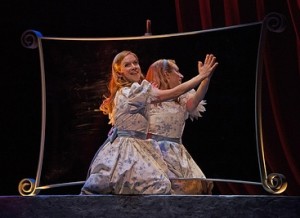
Photos: 1. Trish Lindström as Alice in Alice Through the Looking-Glass; 2. Cynthia Dale as the Red Queen in Alice Through the Looking-Glass. Photos by Cylla von Tiedemann.

Thursday, 29 May 2014

King John: Where burlesque and drama go hand-in-hand

King John
Stratford Festival
Tom Patterson Theatre
Written by William Shakespeare
Directed by Tim Carroll
Approximate running time: 2 hours and 56 minutes (with one 15 minute interval)
May 28-September 20
Toll-free: 1.800.567.1600
519.273.1600

Review by Geoff Dale 
STRATFORDKing John may be one of Shakespeare’s lesser produced works in recent memory but that hasn’t stopped the Festival from staging it several times over the years – at last count four.
Now it’s Tony-nominated director Tim Carroll’s turn to try his luck with the troubling play and, while there are noticeable shortfalls, the overall sense is that it is an imaginative candle-lit effort highlighted by a number of thought-provoking characterizations, not the least of which is Tom McCamus’ startling interpretation of regal off-handedness mixed with grandiose fits of rage and madness.
 
As with all the Bard’s historic efforts there are generous portions of pure fantasy, much needed for a period of British history that appears to be rather confusing and often badly misunderstood by historians of considerable reputation.
One of the most welcome fictional additions is the character of Philip Faulconbridge, otherwise known throughout as the Bastard, reportedly an illegitimate son of Richard the Lionhearted.
Appointed in the early going by John as an officer in his army, the Bastard affords the immensely versatile Graham Abbey much opportunity to play about with the role in an almost burlesque fashion, bellowing, threatening and assaulting his foes both with cutting verbiage and swordplay.
One highlight is the glorious moment Philip matter-of-factly tosses the decapitated bloody heady of a foe into the lap of an unsuspecting but most likely delighted audience member. Howls of approval immediately arise from the crowd.
Now enjoying his second year in the Festival Company Noah Jalava gives a strong and at times commanding and self-assured performance as Arthur, the King’s nephew and apparent heir to the throne. With youthful enthusiasm and an obvious understanding of his role, he clearly provides one of the much-anticipated tragic elements of any Shakespearean production.
As is always the case, the playwright takes great liberties with historic fact, conveniently replacing some to suit his purpose – whether that be to create a foil for the leading character or simply to enliven the action when it lags. To the latter point, that does occur sporadically in both the opening and closing acts.
The simple reality is that fiction more often than not captures greater attention and Carroll does a fine job of accentuating these tastier little bits of John’s life. For example, while it is widely known that John was not actually poisoned by a monk at Swinstead, it’s fair to say this is far more theatrically pleasing than the fact that he actually died of dysentery while on a campaign.
While there is considerably less grandeur than the great works like King Lear and Hamlet, there is still an abundance of wonderful characters with which to play, oft times with wild literary abandon and unchecked poetic license.
Sean McKenna has a veritable field day with Constance, Arthur’s mother – a complex passionate figure of maternal majesty, fiery frenzy and ultimately lonely despair. Her speeches often ring more powerfully than her male counterparts:
“Thou shalt be punish’d for thus frighting me:
For I am sick, and capable of fears;
Oppressed with wrongs, and therefore full of fears.
A widow, husbandless, subject to fears;
A woman, naturally born to fears;
And though thou now confess thou didst but jest
With my vexed spirits, I cannot take a truce,
But they will quake and tremble all this day.”
The always reliable Brian Tree is wonderful as the trouble making papal legate, Cardinal Pandulph, the man who excommunicates John but ultimately accepts the regal repentance. Wayne Best delivers John’s chamberlain Hubert as a troubled man beset with personal conflicts while Patricia Collins shows Eleanor of Aquitaine as a strong-willed woman of self-determination.
In the end Carroll, forgoing elaborate set designs and massive stage-cluttering battle scenes, leaves the fate of the production in McCamus’ hands as the oft times hilarious monarch who casts aside foes with the gentle flick of a TTFN wave, interspersed with uncontrolled bursts of sudden raucous, shrieking threats and gestures.
Often blatantly comic, McCamus brings John to life as a man with considerable human frailties, a monarch that one can easily see as having legions of both friends and foes alike. Clearly less majestic that some of Shakespeare’s kings; the character is nonetheless filled with the possibilities for explorations – both real and imagined.
What will always remain a mystery is why Shakespeare never refers, even casually, to John’s signing of the Magna Carta in June 2015. A small quibble perhaps but it is still one of several questions left unanswered by this curious but fascinating lesser-known production.
Powerful at times but likewise slowly moving, King John’s chief strength lies in its characterizations.
3 ½ stars
Photos: 1. Tom McCamus (centre, left) as King John and Brian Tree as Cardinal Pandulph with members of the company in King John; 2. Seana McKenna as Constance in King John. Photos by David Hou This review also appeared online at Donald's Dish.

Friday, 31 May 2013

Peacock and McKenna shine in Mary Stuart


Mary Stuart
Stratford Festival
Written by Friedrich Schiller
In a new version by Peter Oswald
Directed by Antoni Cimolino
Tom Patterson Theatre
Playing to September 21
Running time: two hours, 47 minutes (with one interval)
Tickets: 1-800-567-1600 or online www.stratfordfestival.ca 


Review by Geoff Dale

One key element in Friedrich Schiller’s play, skillfully updated by Peter Oswald, is that the storyline is historically correct in many details, except for one intriguing “what if” scene – the meeting of Queen Elizabeth 1 and her imprisoned cousin Mary Stuart, Queen of Scotland.
While this work is clearly not the alternative history associated with present-day author Harry Turtledove (Hitler’s War) in which largely fictitious means dictate a complete reversal of the real ending, it is still the powerful and totally imagined scene between the two regal rivals that drives this play along emotional and intellectual journeys.

Equally important is that casting for Mary Stuart be without question or second thoughts. It requires top-flight performers known for flexibility of presentation, able to convey sincerity and compassion at all times through the nearly three-hour play.

Fortunately Lucy Peacock (Mary Stuart) and Seana McKenna (Elizabeth), two of the finest stage actors to be found anywhere in the theatrical world, landed the lead roles. Both exceed reasonable expectations, delivering spell-binding performances that reveal the complexities, power and even frailties of the regal cousins.

The imagined meeting of the two is simply chilling.

Peacock’s Mary Stuart is mesmerizing. As her cousin’s prisoner, she is deprived of her physical freedom but also tormented by her guilty conscience arising from her supposed role in the death of her husband Henry Stuart, Lord Darnley.

She is also at the mercy of several plots, engineered by the free-spirited Mortimer (played with delightful rage by Ian Lake) and the two-faced Earl of Leicester (portrayed with uncomfortable nastiness by Geraint Wyn Davies). Peacock is at the top of her game, delivering to the audience a conflicted soul, a misunderstood figure and clearly seen by the author as the personification of tragedy.

Yet McKenna is equally successful capturing Elizabeth’s different sides, as a strong-minded woman who is nonetheless trapped in her own metaphysical dilemma. Surrounded, seemingly on all sides, by a host of benign court sycophants and self-serving deviants, she is strangely isolated as a leader wielding ultimate power, yet still victimized by her own inner turmoil. The queen, while in control, is nevertheless a symbol of despair and at times out-of-control.

Each actress is afforded ample opportunities to demonstrate the contradictory nature of their characters and both, with the steady and masterful guidance from director Antoni Cimolino, succeed admirably.

Mary’s scenes with her handmaiden Hannah Kennedy (a gentle, touching portrait from Patricia Collins), her jailer Sir Amias Paulet (nicely underplayed with sense of honour by the always reliable James Blendick) and her confessor Melvil (Brian Tree making the necessary shift here from his usual comic persona  to drama)  are simply riveting.

Meanwhile, as she ponders her cousin’s ultimate fate in front of her royal advisors, McKenna’s stone-faced Elizabeth is electrifying. One just has to sit back and marvel as she contends with the potential consequences of executing another monarch, an unthinkable act for the times.

When she and Mary finally meet, their fictional confrontation becomes a multi-layered and glorious tour-de-force of fury-infused acting by the two leads.

Meanwhile, Brian Dennehy is a gracious, dignified and thoughtful Earl of Shrewsbury, begging his queen to act with humanity, not simply respond impulsively to the deafening screams of the crowds milling about, just outside her royal doors. He pleads with her to deal with her dilemma with caution rather than a knee-jerk reaction to unreasoned mob rage.

Blendick’s Paulet, caught perilously between two worlds, remains respectful to both queens but is nonetheless determined to honour his role as Mary’s protector as long as she lives.

Ben Carlson is an unyielding, bloodthirsty Lord Burleigh with no apparent signs of real passion or humanity– a beautifully crafted villain of the highest order. The audience is never left in doubt as to where his motivations lie, contrary to Wyn Davies’s sly vision of the slithering, ever-changing charmer Leicester.

Hats off to Peacock, McKenna, Cimolino and the full company for a ****out of 4 stars night at the theatre.

Geoff Dale is an Oxford County theatre reviewer and freelance writer/photographer. This review is also 
posted  in the Theatre Review section of The Beat Magazine 

Photo by: Don Dixon.  Pictured from left, Seana McKenna and Lucy Peacock.